If you stop mowing a site, you will almost always find a surprising number and variety of flowering perennials appearing. Many of these may be of European or Asian origin but are often relatively benign without need for significant control. A few may be problematic invasives that need to be removed by hand so they don’t take over and reduce diversity. There are many resources to identify what these are in your area, so do a little research start with the xerces Society website.
When adding plants to a new pollinator habitat, or when increasing diversity at an existing site, be careful to only add regionally native ones. It is not helpful to the native bee community to add to the introduced species profile at your site. Always be careful to make sure the plants you are buying are regionally native since some of these places sell plants that are not.
You should use plugs or mature plants from one of the sources listed below whenever possible. If using seeds, start indoors. It is also possible to harvest native plants from no-mow areas or gardens you have legal access and permission to harvest from. If using this option, make sure you are not damaging the originating habitat by removing too many plants.
Successional Blooming Plants for a Native Bee Habitat
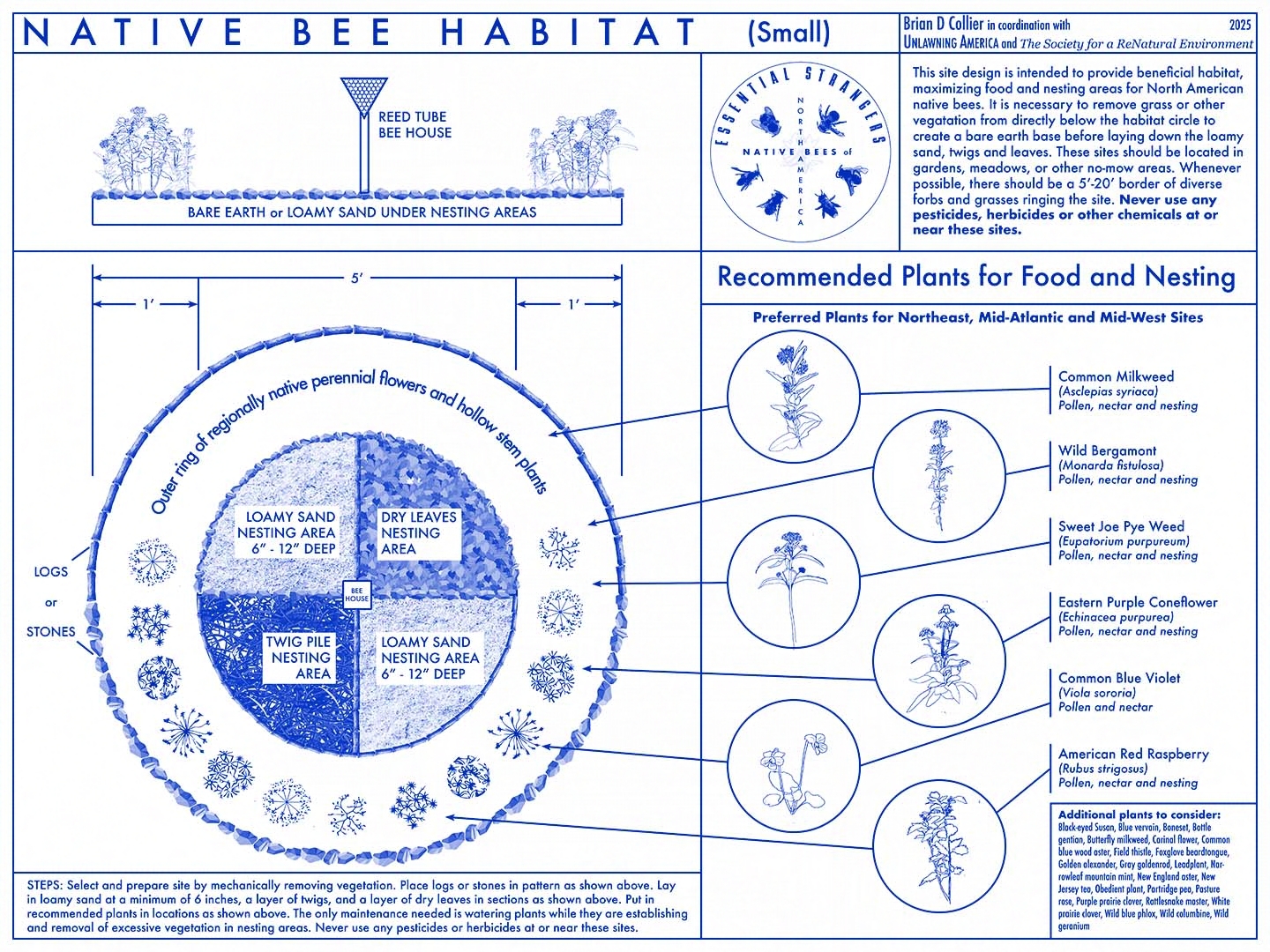
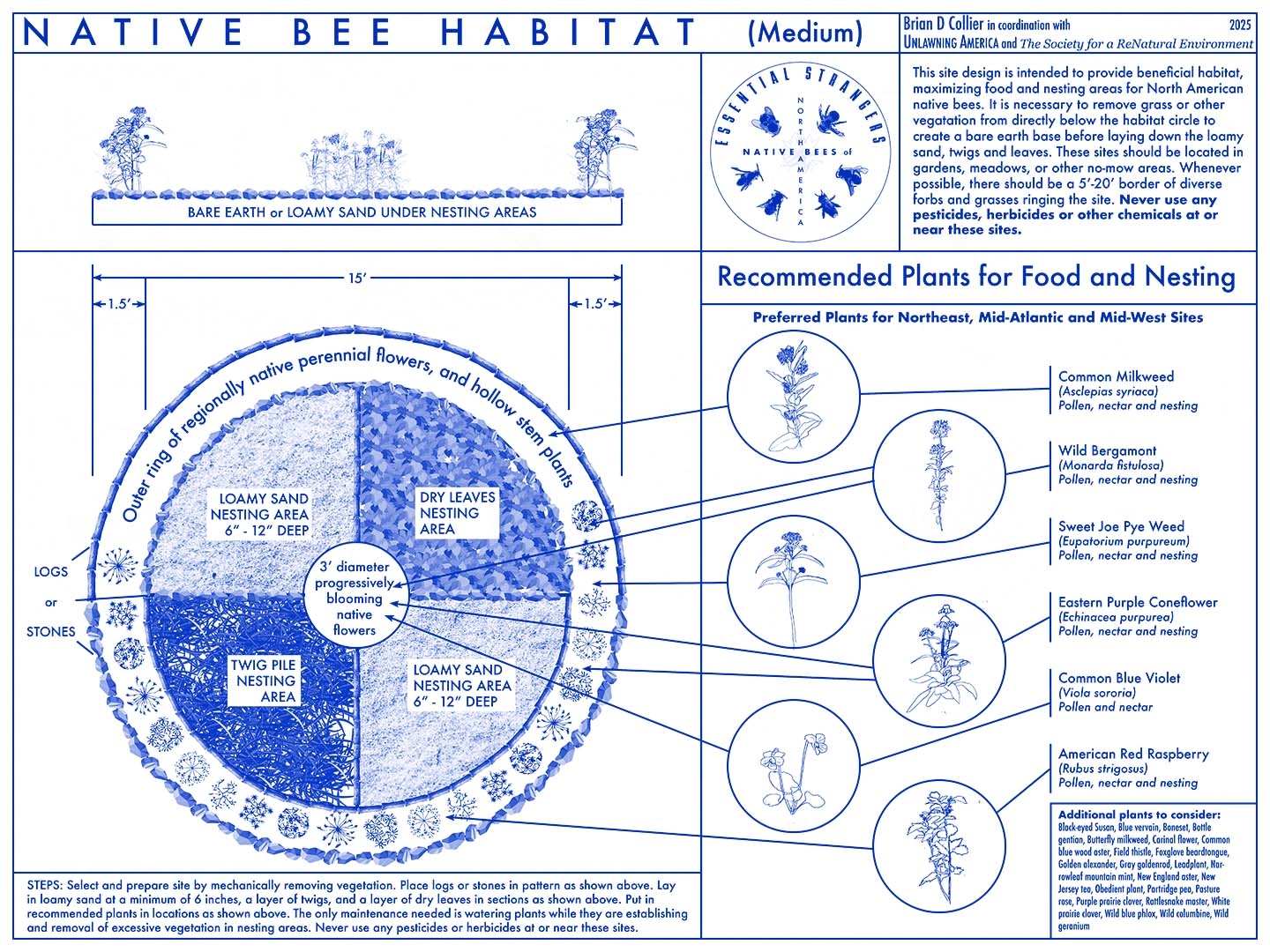
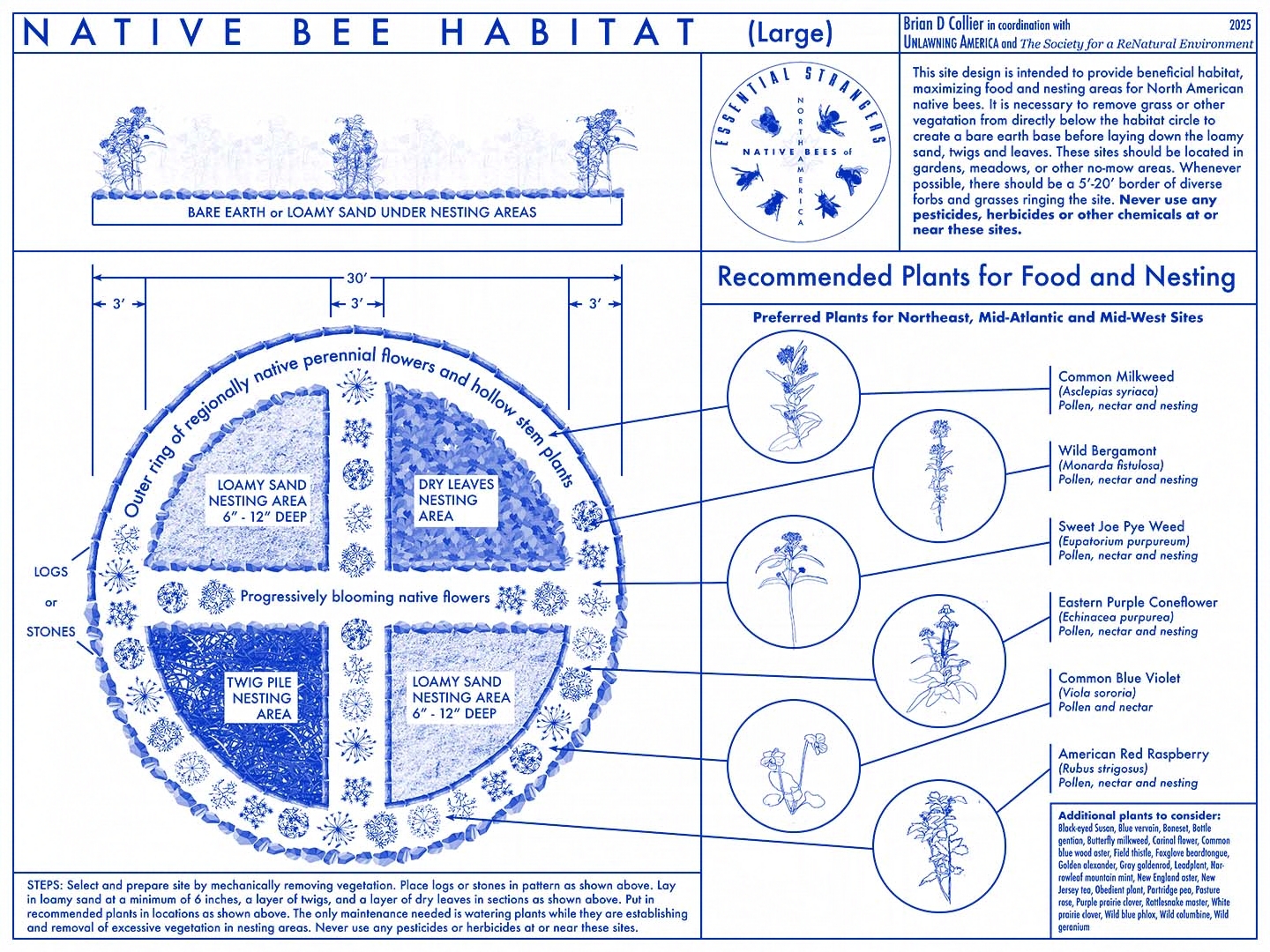
Both the habitat plans, and the lists below present a variety of native perennial plants selected for hardiness and maximizing benefits to a wide range of bees and other animals. The diversity of suggestions is also intended to maximize what will grow best at your site and trying to have something blooming in every season. You will need to carefully assess your site conditions sun exposure, soil moisture and composition) before choosing which plants you’ll put in. The more diversity the better, understanding that some may not do well due to reasons that can be hard to fully understand, and may need to be replaced in the first year or two. This kind of “plant editing” is normal and can be expected.
When selecting which plants you are going to use, in addition to choosing plants that should do well with your site conditions, you should look at which plants are active spreaders*, especially those that are rhizomatic spreaders**, versus those that are slower growing. Active spreaders can outcompete slow growers, especially those that spread through both vigorous self-seeding and rhizomatic growth***, since these may end up dominating a site. If you carefully interplant active spreading plants next to each other, they can often compete without one becoming excessively dominant. Periodic editing is helpful at these sites (a few times a year), especially as the plants are becoming established. If one plant is becoming too dominant, pull some out and replace with other plants that can compete more effectively. This kind of editing is necessary if you want to maintain maximum diversity at the site.
Primary Recommended Plants for the Northeast, Mid-Atlantic and Mid-West
GROWING CONDITIONS KEY:
SUN: fs=sun, ps= partshade, sd=shade
SOIL: w=wet, m=moist, d=dry
GROWTH: sl=slow spreading, as=active spreading self-seeding, ar=active spreading rhizome growth
BLOOMING: er=early season blooming, md=mid-season blooming, lt=late-season blooming
American red raspberry (fs/ps, m/d, as/ar, er/md)
Common Boue Violet (fs/ps, md/d, as/ar, er)
Common Milkweed (fs/ps, w/m/d, as/ar, md)
Sweet Joe-Pye Weed (fs/ps, w/md/d, as/ar, md/lt)
Wild Bergamot, fs/ps (w/md/d, as/ar, md/lt)
Eastern Purple Coneflower (fs/ps, m/d, sl, md/lt)
Black-eyed Susan (fs/ps, m, as/ar, md/lt)
Blue vervain (fs, ps, m/w, sl, md/lt)
Boneset (fs, m/w, as/ar, md/lt)
Bottle gentian (ps/s, m/w, sl, lt)
Butterfly milkweed (fs/ps, m/d, sl, md/lt)
Carinal flower (fs/ps, m/w, sl, md/lt)
Common blue wood aster (ps/sd, m/d, as, lt)
Field thistle (fs/ps, m/d, sl, lt)
Foxglove beardtongue (fs/ps, m/d, sl, er/md)
Golden alexander (fs/ps, m/d, as/ar, er/md)
Gray goldenrod (fs/ps/sd, d, sl, md/lt)
Leadplant (fs/ps, m/d, sl, md/lt)
Narrowleaf mountain mint (fs/ps, w/m/d, sl, md/lt)
New England aster (fs/ps, w/m/d, sl, lt)
New Jersey tea (fs/ps, m/d, sl, md/lt)
Obedient plant (fs/ps, m/w, as/ar, lt)
Partridge pea (fs/ps, m/d, as/ar, md/lt)
Pasture rose (fs/ps, m/d, as/ar, md/lt)
Purple prairie clover (fs/ps, m/d, sl, md/lt)
Rattlesnake master (s, m/d, as/ar, md/lt)
Wild blue phlox (ps/sd, md, sl, er/md)
Wild columbine (s/ps/sd, m/d, sl, er/md)
Wild geranium (s/ps/sd, m/d, sl, er/md)
Other plants to consider by bloom time (*look up growing conditions to match with your site)
*=active spreader by self-seeding
**=active spreader by rhizomatic growth
***=highly active spreader through both self-seeding and rhizomatic growth
EARLY BLOOMING
Spring Beauty
Trout Lilly
Violet**
Wild Strawberry**
Black Cherry** (tree)
Willow*** (tree)
American Crabapple (tree)
MID-EARLY BLOOMING
Lupine*
Eastern Red Columbine
Coral Honeysuckle
Raspberry***
Blueberry
Blackberry***
Service Berry (tree)
Phlox**
MID-LATE BLOOMING
Wild Bergamot***
Common Milkweed***
Butterfly Milkweed
Evening Primrose*
Dogbane*
Field Thistle*
Pasture Thistle*
Yarrow***
LATE BLOOMING
New England Aster***
Sky Blue Aster
Goldenrod***
Sweet Joe Pye***
Jewelweed*
Black-eyed Susan***
Perennial Sunflower***
Obedient Plant***
Native Plant Sources
Wild Seed Project
The Plant Native
Native Plant Trust
Prairie moon Nursery
Garden For Wildlife
American Meadows
Prairie Nursery
New York Native Perennials
Grow Native Mass
High Country Gardens